
Murrieta’s City Directory Shelf
The first task is collection control. Murrieta has confirmed local-history and yearbook resources, a verified Riverside County directory from 1893-94, filmed Riverside telephone-directory metadata, and regional fallback collections. No authoritative catalog located a continuous Murrieta Polk or printed city-directory run. The table keeps confirmed material separate from a lead that still needs a librarian’s check.
| Collection | Years or scope | Where held | Access |
|---|---|---|---|
| Heritage Room archives and photographs | Local institutional eras; exact boxes in finding aid | Murrieta Public Library | Ask staff; browse in person; selected digital projects |
| Heritage Room yearbooks | Discontinuous runs from 1965 through 2011 | Murrieta Public Library | Browse-only; staff does not copy school photographs |
| History and Directory of Riverside County | 1893-94 | Library of Congress scan | Digitized public-domain county volume |
| Riverside telephone directories | January 1950-September 1953; 1956-57; September 1963 | Library of Congress filmed-directory catalog | Inspect locality index; metadata is not proof of a Murrieta entry |
| County marriages and recorder deaths | 1893-1910 marriages; 1893-1919 death registers | FamilySearch catalog and books | Online or film access varies by item |
| Population census | Decennial schedules through 1950 | NARA and partners | 1950 search is free; older access varies |
A reference to a year is not a promise that a Murrieta page survives in that year. Ask for the collection title, publisher, date span, locality index, and reproduction rules before traveling.
Note: A catalog year identifies a collection lead, not a guaranteed Murrieta page or surviving local entry.
Murrieta Directory Heritage Room
The Murrieta Public Library Heritage Room is the best local first stop. The library is at 8 Town Square, with Adult Services at 951-461-6130 or 951-461-6132. Published hours are Monday through Friday, 10 a.m. to 6 p.m., and Saturday, noon to 5 p.m. Call before a visit with the person’s full and alternate names, approximate years, school, business, organization, or street.
The official resource list points to a Family History Guide, Historypin, and Flickr photographs. Its archive inventory includes Murrieta City Government, Murrieta Public Library Establishment, Murrieta Mutual Water Company water certificates, school parent-teacher material, local oral histories, copied newspaper articles, obituaries, and the Pioneers of Murrieta, Buried in Laurel Cemetery collection. These are often better name clues than a generic directory search.
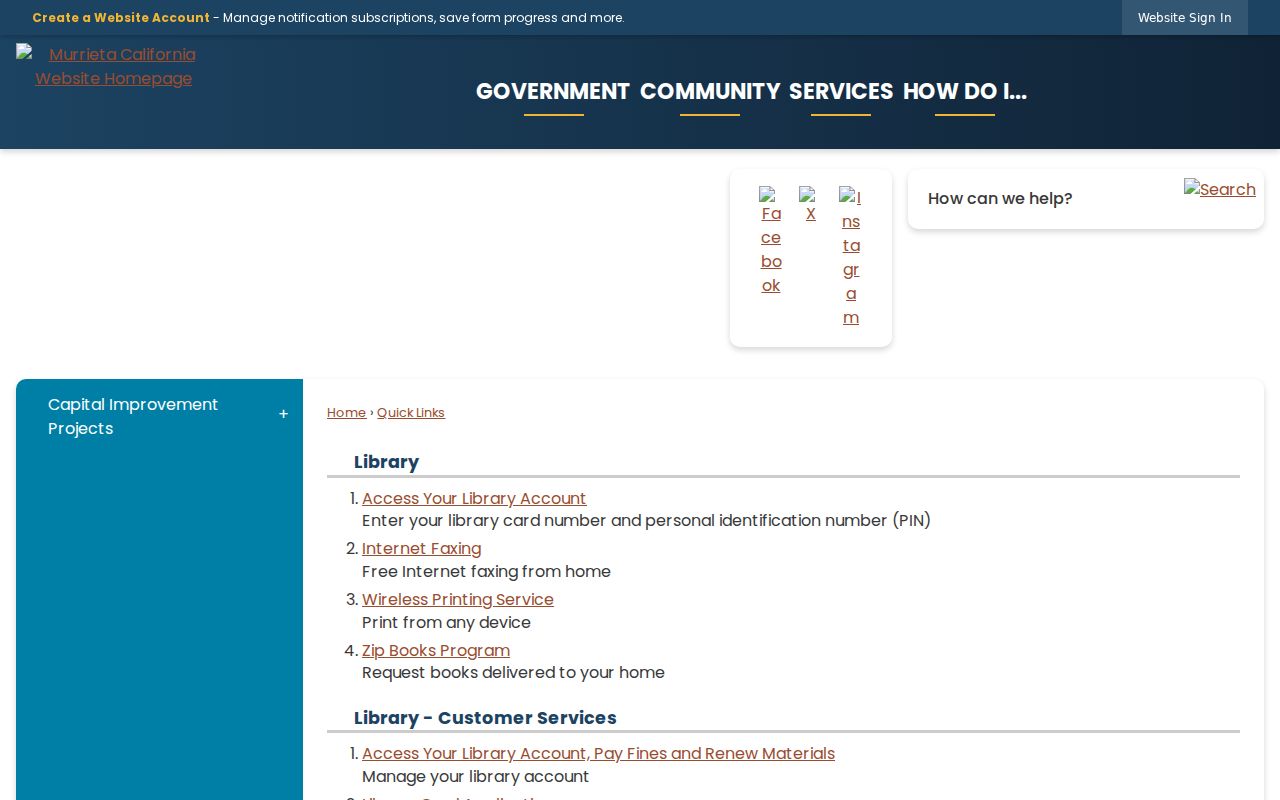
The Murrieta Heritage Room resources capture shows the library’s local-history gateway and its linked digital-memory projects.
Staff can identify whether a vertical file, clipping folder, yearbook, telephone book, or reverse directory is actually on hand. The collection policy favors local and state history plus introductory North American genealogy rather than an exhaustive genealogy shelf.
Note: Call Adult Services before visiting because vertical files and reverse directories may not appear in the public link list.
Murrieta Directory Archive Clues
The archive inventory is unusually useful because it names collections instead of promising a vague “local history” search. Ann Smith, Mary Alice Rail Boyce, Rebecca Farnbach, Ron Wickerd, and Virginia Fenske appear among the named holdings. Photograph groups include the 2008 city photo contest, E. Hale Curran digital photographs, and a general photograph collection. The inventory also identifies records tied to city government, the library’s creation, the water company, schools, and a time capsule.
These collections can connect a resident to a civic project, school, neighborhood, business, or oral-history interview. They do not function like an index. A researcher should ask the archive to identify the exact box or folder, date coverage, access condition, and citation. The same name in a photograph caption and a deed still needs a second anchor. The Heritage Room archives and records inventory controls the named collection list and onsite locations.
Murrieta’s historical society is a regional companion. Its collections describe hundreds of artifacts and thousands of photographs tied to the Hot Springs, schools, military residents, cityhood, fire department, ranching, farming equipment, geology, and household objects. The museum is in Hunt House at 41810 Juniper Street, with published Thursday hours from 1 to 4 and private tours. Holdings are not comprehensively online, so send a full name, date span, street, school, or business association before visiting.
Murrieta Directory Fallbacks from Riverside
The 1893-94 History and Directory of Riverside County by A. A. Bynon & Son was printed by the Riverside Daily Press printing office. It is 152 plus 189 pages and is digitized by the Library of Congress. That volume began in Riverside County’s first year, but it is a county directory, not proof of a yearly Murrieta series. Search the scan and inspect the printed page before citing an entry.
The Library of Congress county-directory record is the authoritative link for that scan. The same catalog lists filmed Riverside telephone directories for January 1950 through September 1953, September 1956 through September 1957, and September 1963. A reel’s locality index must be checked before claiming that Murrieta appears.
Riverside Public Library Local History and UC Riverside special collections provide regional alternatives. A city cultural-resources study also used historic newspapers, USGS maps, Ancestry, and federal General Land Office plats for Township 7 South, Range 3 West, San Bernardino Meridian. The California State Library’s California History Section maintains city-directory and phonebook databases and accepts exact city, county, and year questions.
If a Murrieta city directory is missing, a regional collection can still supply a newspaper notice, map, business listing, or county-level name. State the gap plainly rather than turning a regional source into a local annual run.
Reading a Murrieta City Directory
No open authoritative scan supplied a confirmed Murrieta-specific entry for inspection. A period city directory or telephone volume should therefore be inventoried, not assumed. Look for the name line, spouse or widow notation, occupation, employer or business, home address, telephone, street section, and abbreviation key only when the edition actually includes them.
A reverse volume changes the order. Search the street heading, then the house-number sequence. Note cross streets, vacant lots, rear units, and whether the index follows a telephone subscriber rather than every resident. A business listing may place a person in Murrieta without giving a home address.
- Alphabetical entry
- A personal-name listing that may connect a person to an address, occupation, or telephone.
- Householder index
- A name-based household clue; it is not automatically a complete list of household members.
- Abbreviation key
- The publisher’s explanation for occupation, relationship, address, or telephone marks.
- Criss-cross directory
- A reverse directory searched by street and number, useful for moving from a parcel to a listed name.
Read the page as publisher-collected evidence. Pair it with a deed, census schedule, obituary, yearbook, or permit instead of treating a single line as present-day proof.
Note: Publisher abbreviations must be read from the volume’s own key, not borrowed from another directory.
Why Murrieta Directory Entries Vanish
An absent name can mean a move, death, a gap in publication, a changed street label, a non-subscriber household, an editorial omission, or an index misspelling. It does not prove that a person never lived at the address. Telephone directories can omit people who had no listed service, while yearbooks cover only a school and year, not the whole city.
California names also require careful searching. Compound surnames, diacritics, hyphens, initials, and alternate spellings can be lost in OCR. ACR recorder searching supports sounds-like and uncertain-letter operators. Vital records began accepting specified diacritical marks in 2026 under AB 64, but an older directory may use a different form.
Compare at least adjacent directory years when available. Then use the census, deed chain, obituary, permit record, or local newspaper to explain the gap. A directory is strongest when it agrees with a second source that has a different keeper.
Tracing Murrieta Resident Households
Begin with a known year and address. Confirm the street name against a contemporary map, then read the alphabetical name entry and any address-keyed street entry in the same edition. Keep the exact wording, abbreviation, page number, and repository citation. The goal is to observe a pattern across years, not to fill an unknown year with a guess.
- Write down the known address, person, family link, and approximate date range.
- Check the alphabetical entry and street section in the same volume, if both exist.
- Compare adjacent editions to distinguish a move or omission from a missing volume.
- At census years, match names, ages, relationships, and place. At other years, use deeds, voter material where lawful, newspapers, permits, and yearbooks.
- Record the publisher, volume, page, repository, and access limits so another researcher can reproduce the trail.
For a modern address, the current parcel chain belongs with the address-focused workflow on the Murrieta street directory page. The city directory task remains the historical reading and collection question.
Murrieta Directories and the Census
NARA makes the 1950 population schedule freely searchable, and the 72-year access rule makes it the latest public population schedule in the research set. Work backward through 1940, 1930, and earlier decades. When OCR misses a surname, browse the enumeration district or address. Murrieta’s small historic population makes township and precinct geography important, as do variant spellings.
A directory fills years between census schedules but uses different evidence. A census records a household on an enumeration date. A directory may be collected over months, may follow subscribers, and may abbreviate relationships. Compare ages and relationships at census years, then use the directory for an address or occupation clue.
The NARA 1950 Census collection is free to search. The Riverside NARA facility at 23123 Cajalco Road in Perris also offers genealogy research in census, military, passenger, passport, federal-land, naturalization, and district-court material. Central District naturalization coverage has separate index, declaration, and petition date ranges, so geography and year must be checked.
Note: Census geography may use a township or precinct label that predates the modern city boundary.
Murrieta Directory Maps for Old Streets
Historical maps can keep a directory trail from breaking when a rural description becomes a modern subdivision. The research record cites federal land plats from 1854-1883, the 1901 Elsinore quadrangle, 1942 and 1953 Murrieta sheets, and a 1979 photorevision. These maps show land and place-name continuity, not who occupied a house.
Use a legal description, lot or block, subdivision, cross street, or parcel clue to compare the old map with the present address. Murrieta’s 1884 townsite grid and later annexation history mean that postal, city, county, and historical labels can diverge. No verified citywide street-renumbering event was found, so an address change must be proved from a deed, map, or local record.
| Map or record | Use in city directory research |
|---|---|
| GLO plats, 1854-1883 | Bridge early land descriptions and township geography. |
| 1901 Elsinore quadrangle | Compare historic regional place names and roads. |
| 1942 and 1953 Murrieta sheets | Check mid-century road and settlement context. |
| 1979 photorevision | Compare later rural-to-subdivision change. |
Murrieta Record Custody Seam
Riverside County was created in 1893 from parts of San Bernardino and San Diego counties. Murrieta incorporated in 1991. Those two dates explain why an older name or address may move between predecessor-county material, Riverside County books, and later city records. A city directory researcher should name the geography used in every search instead of assuming that modern Murrieta was always the record keeper.
| Era | Useful custodian or source | What the seam changes |
|---|---|---|
| Before 1893 | Predecessor-county, land, church, newspaper, and archive sources | Riverside County did not yet hold every local record. |
| 1893-1990 | Riverside County, Heritage Room, regional libraries, maps, census | County and local-history sources carry most civic context. |
| 1991 forward | Murrieta City Clerk, Development Services, library, and county offices | City permits and municipal files become a separate custody track. |
A missing Murrieta city directory page is therefore not the same as a missing resident. It may be a catalog, geography, or custody problem. Ask the repository for the exact series and then cross-check the name in a different record family.